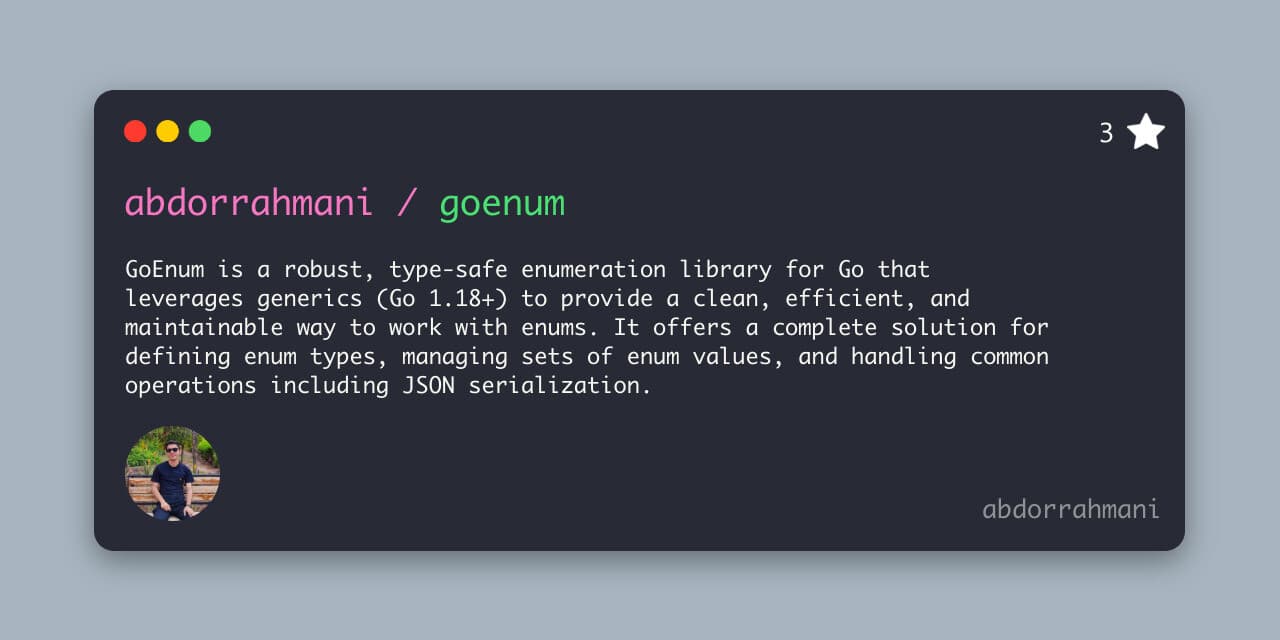
Enumerations, or enums, are a staple in many programming languages, offering a way to define a set of named values. However, Go (Golang) lacks a built-in enum type, leaving developers to rely on constants or other workarounds. This can lead to code that is less type-safe, harder to maintain, and prone to errors. Enter GoEnum, a powerful, type-safe enum library for Go that leverages generics (introduced in Go 1.18) to provide a robust solution for defining and managing enums.
In this article, we'll explore the challenges of implementing enums in Go, introduce the GoEnum package, and demonstrate how it simplifies enum handling with practical examples. Whether you're building a small project or a large-scale application, GoEnum offers a clean, efficient, and extensible way to work with enums in Go.
Why Enums Matter in Go
Enums are essential for defining a fixed set of values, such as statuses, priorities, or categories. In Go, developers typically use constants to mimic enums:
1const (
2    StatusPending = 0
3    StatusActive  = 1
4    StatusDone    = 2
5)
While this approach works, it has limitations:
- Lack of Type Safety: Constants are just integers or strings, so you can accidentally assign invalid values.
- No Built-in Validation: There's no way to ensure a value belongs to the defined set.
- Limited Functionality: Operations like JSON serialization, value lookup, or alias management require custom code.
- Maintenance Challenges: Adding descriptions or aliases to constants is cumbersome.
GoEnum addresses these issues by providing a type-safe, feature-rich enum library that integrates seamlessly with Go's ecosystem.
Introducing GoEnum: A Modern Enum Solution
GoEnum is an open-source library designed to bring robust enum support to Go. Built with Go generics, it offers a flexible and idiomatic way to define enums, manage sets of values, and handle common operations like JSON serialization. Key features include:
- Type Safety: Enforce compile-time checks using generics.
- Rich Metadata: Support for descriptions, aliases, and custom values (integers or strings).
- Enum Sets: Efficiently manage collections of enum values with lookup capabilities.
- JSON Support: Seamless marshaling and unmarshaling for API integration.
- Nil Safety: Graceful handling of uninitialized enums.
- Comprehensive Testing: A robust test suite ensures reliability.
GoEnum is ideal for developers seeking a maintainable, scalable solution for enums in Go projects.
Getting Started with GoEnum
Installation
To use GoEnum, you need Go 1.18 or higher. Install the package with:
1go get github.com/abdorrahmani/goenum
Basic Setup
Let's create a simple enum for colors using GoEnum. Here's a complete example:
1package main
2
3import (
4    "fmt"
5    "github.com/abdorrahmani/goenum"
6)
7
8type Color struct {
9    *goenum.EnumBase
10}
11
12var (
13    ColorRed   = Color{goenum.NewEnumBase(1, "RED", "The color red", "CRIMSON")}
14    ColorBlue  = Color{goenum.NewEnumBase(2, "BLUE", "The color blue", "AZURE")}
15    ColorGreen = Color{goenum.NewEnumBase(3, "GREEN", "The color green", "EMERALD")}
16)
17
18var Colors = goenum.NewEnumSet[Color]()
19
20func init() {
21    if err := Colors.Register(ColorRed); err != nil {
22        panic(err)
23    }
24    if err := Colors.Register(ColorBlue); err != nil {
25        panic(err)
26    }
27    if err := Colors.Register(ColorGreen); err != nil {
28        panic(err)
29    }
30}
31
32func main() {
33    fmt.Println(ColorRed.String())      // Output: RED
34    fmt.Println(ColorRed.Value())       // Output: 1
35    fmt.Println(ColorRed.Description()) // Output: The color red
36    fmt.Println(ColorRed.HasAlias("CRIMSON")) // Output: true
37}
In this example:
- We define a Color type embedding goenum.EnumBase.
- Each color is an instance with a value, name, description, and optional aliases.
- The Colors set manages all color enums, enabling lookups and validation.
- The init function registers enums to ensure uniqueness and prevent duplicates.
Practical Use Cases
1. Basic Enum Operations
GoEnum makes it easy to access enum properties and perform validations:
1package main
2
3import (
4    "fmt"
5    "github.com/abdorrahmani/goenum"
6)
7
8type Status struct {
9    *goenum.EnumBase
10}
11
12var (
13    StatusPending = Status{goenum.NewEnumBase(0, "PENDING", "Waiting to be processed", "WAITING")}
14    StatusActive  = Status{goenum.NewEnumBase(1, "ACTIVE", "Currently active", "RUNNING")}
15)
16
17func main() {
18    fmt.Println(StatusPending.String())      // Output: PENDING
19    fmt.Println(StatusPending.Value())       // Output: 0
20    fmt.Println(StatusPending.Description()) // Output: Waiting to be processed
21    fmt.Println(StatusPending.HasAlias("WAITING")) // Output: true
22
23    var invalid Status
24    fmt.Println(invalid.IsValid()) // Output: false
25}
This example demonstrates how GoEnum provides type-safe access to enum properties and handles invalid states.
2. Managing Enum Sets
Enum sets allow you to group and query enums efficiently:
1var Statuses = goenum.NewEnumSet[Status]()
2
3func init() {
4    Statuses.Register(StatusPending)
5    Statuses.Register(StatusActive)
6}
7
8func main() {
9    // Lookup by name
10    if status, exists := Statuses.GetByName("ACTIVE"); exists {
11        fmt.Println(status.Value()) // Output: 1
12    }
13
14    // Lookup by value
15    if status, exists := Statuses.GetByValue(0); exists {
16        fmt.Println(status.String()) // Output: PENDING
17    }
18
19    // Lookup by alias
20    if status, exists := Statuses.GetByName("WAITING"); exists {
21        fmt.Println(status.String()) // Output: PENDING
22    }
23
24    // List all enums
25    for _, s := range Statuses.Values() {
26        fmt.Printf("%s: %v\n", s.String(), s.Value())
27    }
28}
Enum sets provide fast lookups by name, value, or alias, making them perfect for validation and data processing.
3. JSON Serialization
GoEnum supports seamless JSON integration, crucial for APIs:
1type Status struct {
2    *goenum.EnumBase
3}
4
5func (s Status) MarshalJSON() ([]byte, error) {
6    if s.EnumBase == nil {
7        return json.Marshal("")
8    }
9    return s.EnumBase.MarshalJSON()
10}
11
12func (s *Status) UnmarshalJSON(data []byte) error {
13    if s.EnumBase == nil {
14        s.EnumBase = &goenum.EnumBase{}
15    }
16    return s.EnumBase.UnmarshalJSON(data)
17}
18
19func main() {
20    // Marshal to JSON
21    data, _ := json.Marshal(StatusActive)
22    fmt.Println(string(data)) // Output: "ACTIVE"
23
24    // Unmarshal from JSON
25    var status Status
26    json.Unmarshal([]byte(`"PENDING"`), &status)
27    fmt.Println(status.String()) // Output: PENDING
28}
This ensures enums are serialized as their string names and can be deserialized back into the correct enum instance.
4. Advanced Features: String-Based Enums and Aliases
GoEnum supports string-based enum values and multiple aliases, adding flexibility:
1type Priority struct {
2    *goenum.EnumBase
3}
4
5var (
6    PriorityLow    = Priority{goenum.NewEnumBase("low", "LOW", "Low priority task", "MINOR")}
7    PriorityMedium = Priority{goenum.NewEnumBase("medium", "MEDIUM", "Medium priority task", "NORMAL")}
8    PriorityHigh   = Priority{goenum.NewEnumBase("high", "HIGH", "High priority task", "URGENT", "CRITICAL")}
9)
10
11var Priorities = goenum.NewEnumSet[Priority]()
12
13func init() {
14    Priorities.Register(PriorityLow)
15    Priorities.Register(PriorityMedium)
16    Priorities.Register(PriorityHigh)
17}
18
19func main() {
20    fmt.Println(PriorityHigh.Value()) // Output: high
21    fmt.Println(PriorityHigh.HasAlias("CRITICAL")) // Output: true
22    fmt.Println(PriorityHigh.Aliases()) // Output: [URGENT CRITICAL]
23}
This is useful for scenarios where string-based identifiers or multiple synonyms are needed.
Best Practices for Using GoEnum
To maximize the benefits of GoEnum, follow these guidelines:
- Register Enums in init(): Ensure all enums are registered during initialization to catch duplicates early.
- Use Uppercase Names: Align with Go's constant naming conventions for consistency
- Implement JSON Methods: Add custom
MarshalJSONandUnmarshalJSONmethods for structs embedding enums. - Leverage Descriptions and Aliases: Use meaningful descriptions and aliases to improve code readability and flexibility.
- Handle Errors: Check for registration errors to avoid runtime issues.
- Keep Enum Sets Unique: Ensure each enum set contains unique values and names.
Why Choose GoEnum?
Compared to traditional constant-based enums or other libraries, GoEnum stands out for its:
- Type Safety: Generics ensure compile-time checks, reducing runtime errors.
- Flexibility: Supports both integer and string values, plus aliases and descriptions.
- Ease of Use: Intuitive API with comprehensive documentation.
- Extensibility: Easily integrate with custom types and advanced use cases.
- Reliability: Backed by a thorough test suite and active maintenance.
Conclusion
Enums are a critical tool for writing clear, maintainable code, but Go's lack of native enum support can be a challenge. The GoEnum library fills this gap with a modern, type-safe, and feature-rich solution. By leveraging Go generics, GoEnum provides a robust way to define enums, manage sets, and handle serialization, all while maintaining Go's idiomatic style.
Whether you're building APIs, managing state, or categorizing data, GoEnum simplifies enum handling and enhances code quality. Try it in your next Go project and experience the benefits of type-safe enums firsthand.
Get started with GoEnum: GitHub Repository